The "Growth Magnet" Framework: A B2C Blueprint for the AI Era
How one solo founder hit $1M ARR in three weeks with zero ad spend and the repeatable B2C framework behind it.


.png)
For a long time, building a successful Business-to-Consumer (B2C) startup meant mastering a brutal economic game. The playbook went like this: secure venture funding, pump cash into Meta and Google ads to lower your Customer Acquisition Cost (CAC), and pray your user Lifetime Value (LTV) eventually balances out.
Then came Maor Shlomo.

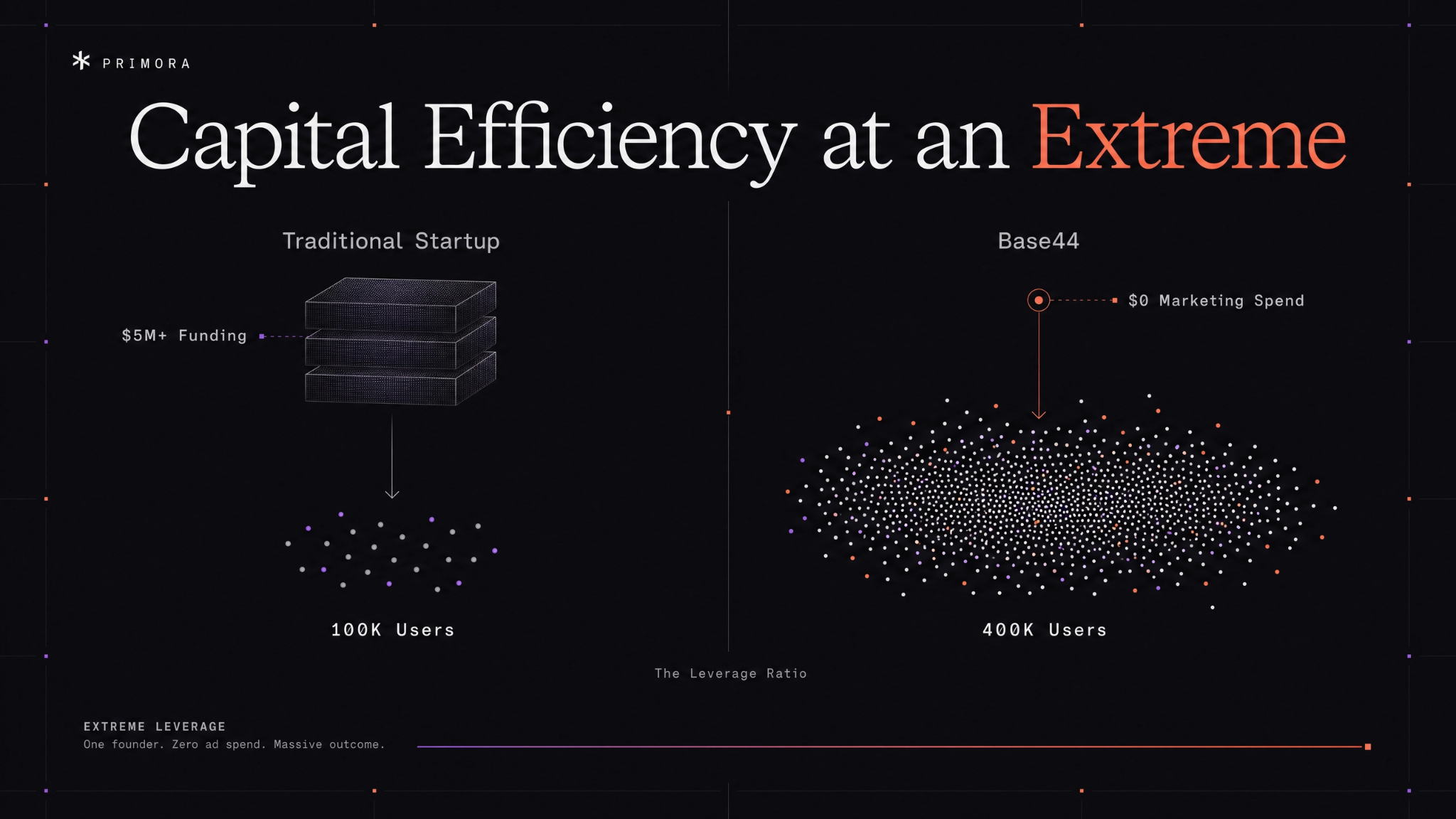
In early 2025, operating completely solo while navigating severe ADHD and managing extended wartime military reserve duty in Israel, Shlomo launched Base44, an AI platform allowing anyone to build full-stack web applications using plain English.
Within three weeks, Base44 hit $1 million in Annual Recurring Revenue (ARR). By month six, it had captured over 400,000 consumer users. Shortly after, website-building giant Wix acquired Base44 for $80 million (a figure that has since climbed past $170 million as Base44's ARR soared toward $150 million inside Wix).
Shlomo’s ad budget? Zero dollars.
Shlomo didn't chase consumers; he attracted them. This institutional guide breaks down The Growth Magnet Framework: a B2C methodology that replaces expensive marketing funnels with a product that naturally draws users in.
Move from Polished Ads to "Radical Authenticity"
Traditional B2C marketing relies on highly curated, expensive brand campaigns. The Growth Magnet framework flips this, utilizing raw, unedited transparency to build immediate trust and emotional resonance with consumers.
Shlomo didn't hire a PR firm. He turned his personal LinkedIn and Twitter feeds into a transparent, daily chronicle of his founder journey. When the system crashed, he posted about it. When he was coding from a military base under missile alerts, he shared that reality.
Consumers in the digital age are fiercely resistant to traditional ads, but they are deeply drawn to compelling human stories. By inviting his audience behind the curtain, Shlomo transformed passive observers into a loyal community. They didn't just want the tool, they wanted him to succeed.
The B2C Playbook
- Document the Friction: Stop hiding your product's flaws. Share the bugs you are actively fixing. It humanizes your brand and sets realistic consumer expectations.
- Make Milestones Shared Victories: When Shlomo publicly celebrated hitting $10k, $50k, and $250k in Monthly Recurring Revenue (MRR), his users felt like part of the winning team because they helped build it.
Implement "Over-the-Shoulder" Product Optimization
Quantitative dashboards like Google Analytics or Mixpanel tell you where consumer users drop off, but they cannot tell you why. For a consumer app to achieve hyper-growth, the product experience must be entirely frictionless.
Instead of hiding behind dashboards, Shlomo sat down next to his earliest users, his friends, his girlfriend as she tried to scale her art business, and volunteers at the local youth scouts group. He watched their hands. He noted exactly where their eyes lingered, where they hesitated, and where they clicked out of confusion.
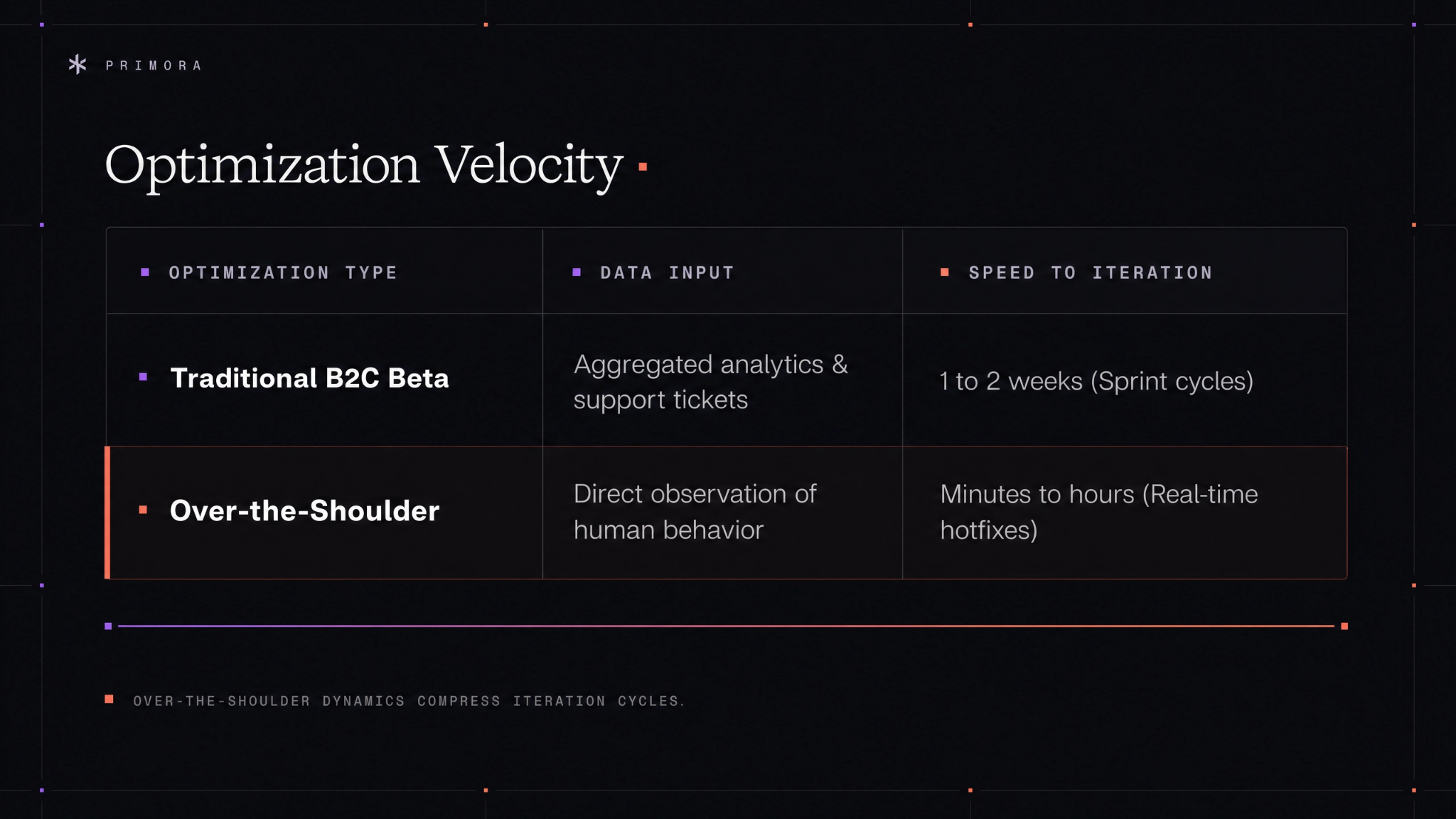
By optimizing for immediate human clarity over abstract data, Shlomo simplified the product until a completely non-technical user could describe an idea and see a live app deploy in seconds.
The B2C Playbook
- The Unguided User Test: Sit down with five target consumers. Give them your app without a single word of instruction. Watch them silently. Every time they hesitate, your product has failed them. Fix that friction point before spending money on acquisition.
- Hyper-Speed Hotfixes: When an early user encounters a hitch, fix it instantly. Showing a consumer that their personal feedback impacts the product within hours creates an evangelist for life.
Engineer Intrinsic Social Currency Loops
True B2C viral growth happens when using the product naturally displays its value to the user's personal network. You shouldn't have to ask users to refer friends; the product should do it for them.
Base44 embedded this loop into its core mechanics. Every time a consumer generated a new application on the platform, Base44 provided them with a unique, live preview URL. When users proudly shared their creations on social media or with friends, they weren't just showing off their work, they were showcasing Base44's core value proposition.
To accelerate this, Shlomo added a simple incentive: users who documented and posted their building journey on social media were instantly rewarded with extra platform creation credits.
The B2C Playbook
- Make Outputs Shareable by Default: If you build a B2C product, ensure the user’s final output can be shared with a single tap. The output itself should serve as a subtle billboard for your platform.
- Incentivize with Core Utility: Do not offer cash discounts or gift cards for referrals. Reward your users with your app's core utility, whether that means processing credits, extra storage, or premium features.
Protect Your "Genius Zone"
In a lean B2C startup, the founder's time is the ultimate constraint. It is incredibly easy to get bogged down in administrative tasks, customer service emails, and minor operational fires, completely stalling product development.
Shlomo managed a massive scale by automating his own operational overhead. He used Base44 to build internal AI tools that managed his workflows and streamlined his content creation engine. This allowed him to fiercely protect his focus.
The 50% Rule: A founder must spend at least half of their working hours inside their "Genius Zone" , the high-leverage tasks where their unique skills directly move the product or narrative forward.
The Lean AI Stack
To outpace heavily funded corporate competitors as a solo creator, Shlomo optimized his technical decisions for speed and AI collaboration:
- LLM-Suitable Repositories: Keep your codebase highly modular and cleanly organized so that AI coding assistants can read, debug, and write features without hitting token limits or losing context.
- Choosing JavaScript over TypeScript for AI Speed: While large corporate development teams rely on TypeScript for strict safety, Shlomo deliberately chose standard JavaScript/JSX. Because LLMs are trained on vast horizons of standard JavaScript, they generate vanilla JS with far fewer hallucinations and syntax errors. This allowed his AI tools to code at blistering speeds, keeping his development loops tight and responsive to consumer needs.
Strategic Checklist for B2C Founders
To transition your startup from a capital-heavy outbound model to a self-sustaining Growth Magnet, execute these steps:
- Conduct an Operational Audit: Track your time for a week. Eliminate or automate administrative tasks until at least 50% of your calendar is dedicated entirely to product engineering and narrative distribution.
- Eliminate Sign-up and Usage Friction: Spend an afternoon watching real people use your app without helping them. Ruthlessly cut every step, prompt, or form that causes a user to pause.
- Build the Inbound Engine: Stop writing corporate copy. Start sharing your real, unedited building journey on channels where your target audience lives. Let them fall in love with the process, and they will naturally advocate for the product.
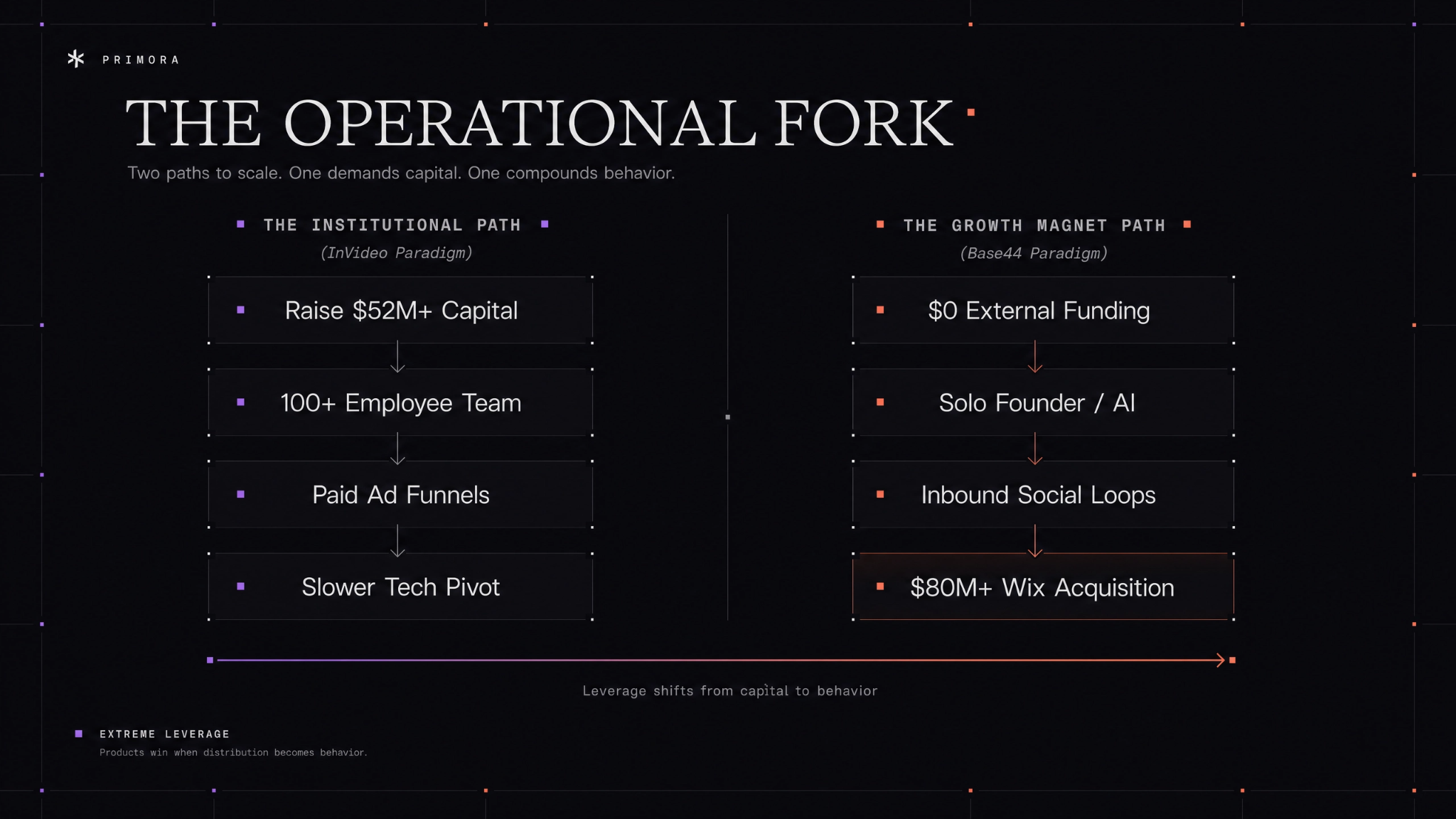
While heavily funded platforms like InVideo continuously fight to maintain consumer attention against rising ad costs and heavy operational overhead, Base44 proved that a lean product built with native social loops can scale faster, with zero marketing capital.
Wix acquired Base44 for $80 million within six months of its founding precisely because Shlomo proved that in the AI era, massive headcount and venture capital are no longer defensible moats. The modern asymmetric edge belongs entirely to the builder who leverages AI to automate complexity, speaks with radical honesty, and designs a product that markets itself.






Build beyond the current cycle
Markets move. Interfaces evolve. Incentives shift. What endures is structure. If your ambition extends past momentum,