How Dropbox and Duolingo Stopped Chasing Hype and Engineered Real Growth From Human Data
How Dropbox and Duolingo ditched marketing hype and grew explosively by watching real users, fixing onboarding friction, and engineering growth from human behavior—not ad spend.


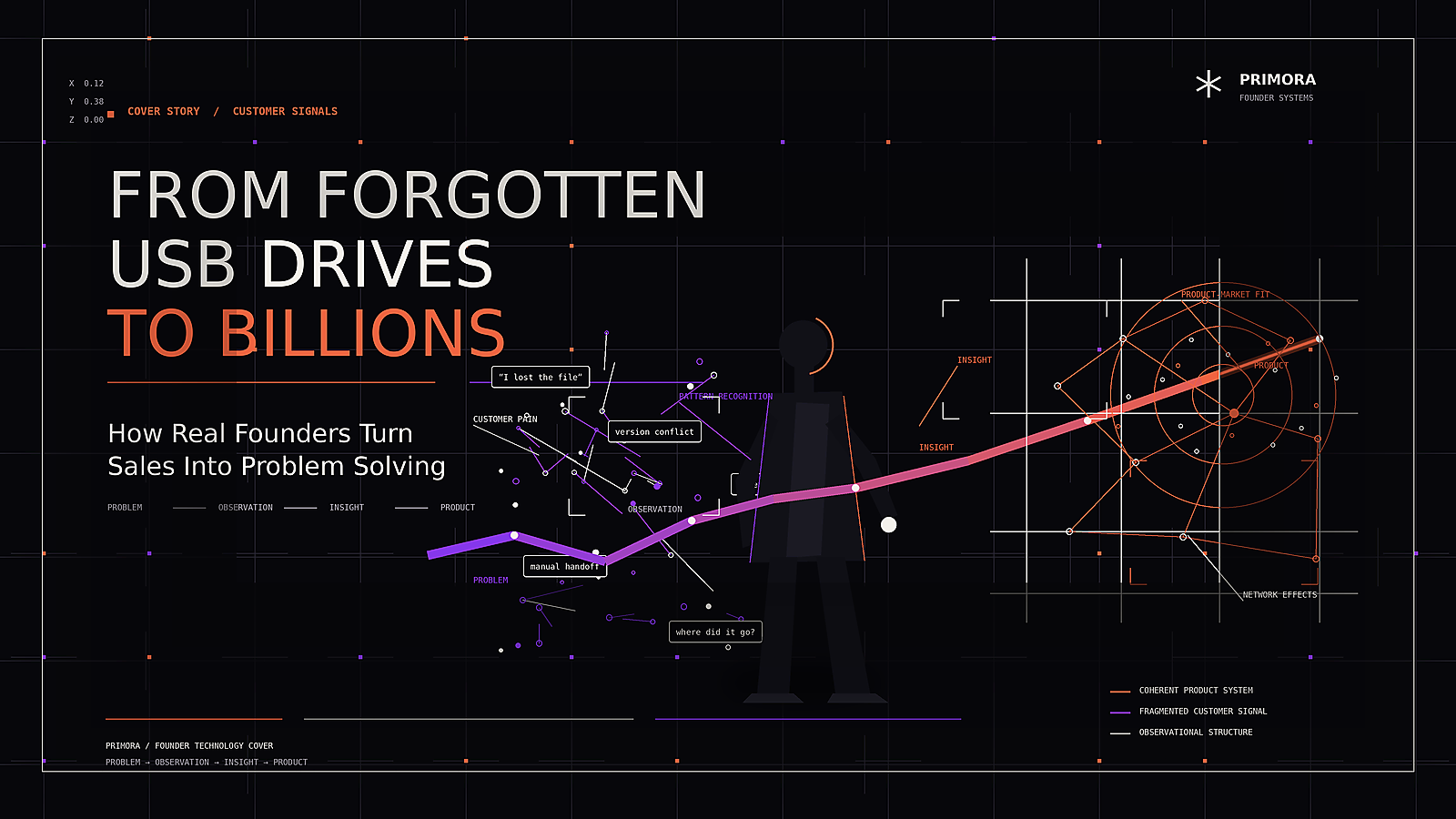
Picture this: It’s 2007. A young engineer named Drew Houston is sitting on a Greyhound bus from Boston to New York. He settles in, pulls out his laptop to get some work done, and freezes.
He left his USB thumb drive back in his apartment. Again.
Stuck on a multi-hour bus ride with zero access to his files, he’s furious. Out of sheer frustration, he opens a text editor and starts writing a piece of code to sync files over the web. That moment of personal annoyance became Dropbox.
But the part most founders miss isn’t the bus ride; it’s the math that followed. Drew didn't hide behind a monitor waiting for the code to be perfect. He realized he had to see how real people actually struggled with files. He recorded a dead-simple, four-minute video showing exactly how the tool solved his headache.
That raw video drove their beta waiting list from 5,000 to 75,000 names overnight. Drew and his co-founder, Arash Ferdowsi, didn't hire a marketing agency to manage the growth. They hopped into tech forums, talked directly to individual users, and fixed sync bugs on the fly.
They realized a fundamental truth that applies to every consumer startup: Growth isn't a magical marketing stunt. It’s just finding the hidden friction points in your onboarding and engineering them out of existence.
The "Growth Hacker" Myth
Too many consumer founders have a cartoonish image of B2C growth in their heads, that it's all about secret algorithmic hacks or throwing money at ads. Early on, Drew Houston tried the traditional playbook. Dropbox spent heavily on Google AdWords, only to realize they were paying between $233 and $388 to acquire a single user for a product that cost just $99 a year.
It was a fast track to bankruptcy.
So they stopped looking at marketing dashboards and started looking at user data. Drew brought in Sean Ellis (the marketer who actually coined the term "growth hacker") to analyze their internal metrics. Sean discovered a fascinating data point: 33% of all their early signups were already coming from organic word-of-mouth.
Instead of trying to force paid ads to work, they built a system to supercharge what users were already doing. They launched their famous two-sided referral program: invite a friend, and you both get 500MB of free space.
The result? Dropbox exploded from 100,000 to 4,000,000 registered users in just 15 months, a 3,900% increase fueled entirely by a permanent 60% bump in organic referral volume.

The Danger of Vague Metrics
When consumer acquisition stalls, a lot of founders panic. They instantly slash prices, extend free trials, or buy low-quality traffic just to make the daily signups chart look good.
But if someone doesn't find value in your app, making it cheaper won't keep them around. High signups mean nothing if your Day 1 retention is flatlining.
In B2C, you cannot outsource early user onboarding to automated email sequences too early. You need to watch real people try to navigate your app for the first time. Watch where their mouse hovers, notice where they hit a wall, and fix the leaks in your funnel manually before you ever try to scale it.
Do the Non-Scalable Onboarding
Many founders run away from high-touch user feedback because they think, "We're a modern consumer app, everything has to scale automatically via data pipelines and AI."
Look at how Luis von Ahn and his early team scaled Duolingo. Long after they had millions of users, they didn't just look at abstract charts to fix their notoriously leaky onboarding funnel. When data showed that massive cohorts of users were dropping off within their first 24 hours, Luis didn't just guess at the solution from an executive office.
The product team ran intensive, high-touch user testing labs. They sat regular people down in front of phones, hit records, and watched them struggle. They discovered that users were hitting a wall before they even learned a single word of a language, simply because the app forced them to create a username and password first.
It was a clunky, high-friction gate.
So they did the unglamorous work of re-engineering the entire psychology of their onboarding. They flipped the script: let users try a fun, 2-minute lesson first, let them feel the dopamine hit of a win, and only ask them to register an account once they are already hooked.
That single, obsessively observed shift in human behavior skyrocketed their Day 1 retention by roughly 20%. It laid the groundwork for Duolingo’s legendary gamification engine, which now powers over 100 million active users. They didn’t achieve viral scale by ignoring the messy, individual human experience; they achieved it by obsessing over it.

Your Shift in Perspective
If your app genuinely solves a real, everyday problem, growing it isn't about manipulation, clever ad copy, or waiting for a viral miracle. It's about finding the hidden friction points in your user journey and engineering them out of existence.
So, ditch the cartoon version of growth marketing. Stop guessing what your users want based on generic industry advice. Channel the raw, data-driven intensity of founders like Drew Houston and Luis von Ahn. Look over a user's shoulder. Track the precise moment they lose interest. Every user drop-off is a roadmap item. Every uninstalled app is a free lesson in where your onboarding failed.
Stop explaining your features. Just fix the exact moment your users get confused. Go ahead and build something your users can't imagine deleting.
Before You Code Your Next Feature...
Take a hard look at your current user metrics today and ask yourself these three questions:
- Where is the cliff? At what exact screen or minute do 50% of your new users close the app and never return?
- When was the last time you watched a stranger use your app? Have you actually sat down and watched someone navigate your onboarding without dropping a single hint?
- Are you fixing symptoms or human behavior? Are you offering discounts and sending push notifications to mask a bad initial experience?
Your Next Move: Don't hide behind a dashboard trying to guess why people are leaving. Pull up your user journey and find the exact spot where the momentum dies. If you aren't sure where that is, talk to your users, or bounce your metrics off someone who can help you look at the data objectively.
The goal isn't to market your way out of a leaky funnel. It’s just to fix the product so people can actually use it.







Build beyond the current cycle
Markets move. Interfaces evolve. Incentives shift. What endures is structure. If your ambition extends past momentum,