The 90% Failure Curve: What Stripe, Airbnb, and Amplitude Knew About Product-Market Fit That Most Founders Miss
A data-backed breakdown of how Stripe, Airbnb, and Segment survived early chaos reveals that the founders who reach PMF aren't the most prepare, they're the most evolvable.



Billion-dollar companies aren't born polished, they're forged in chaos through thousands of messy micro-decisions. The sleek "up-and-to-the-right" charts in pitch decks hide the truth: 90% of startups fail, and 34% of those failures stem directly from lacking product-market fit (PMF).
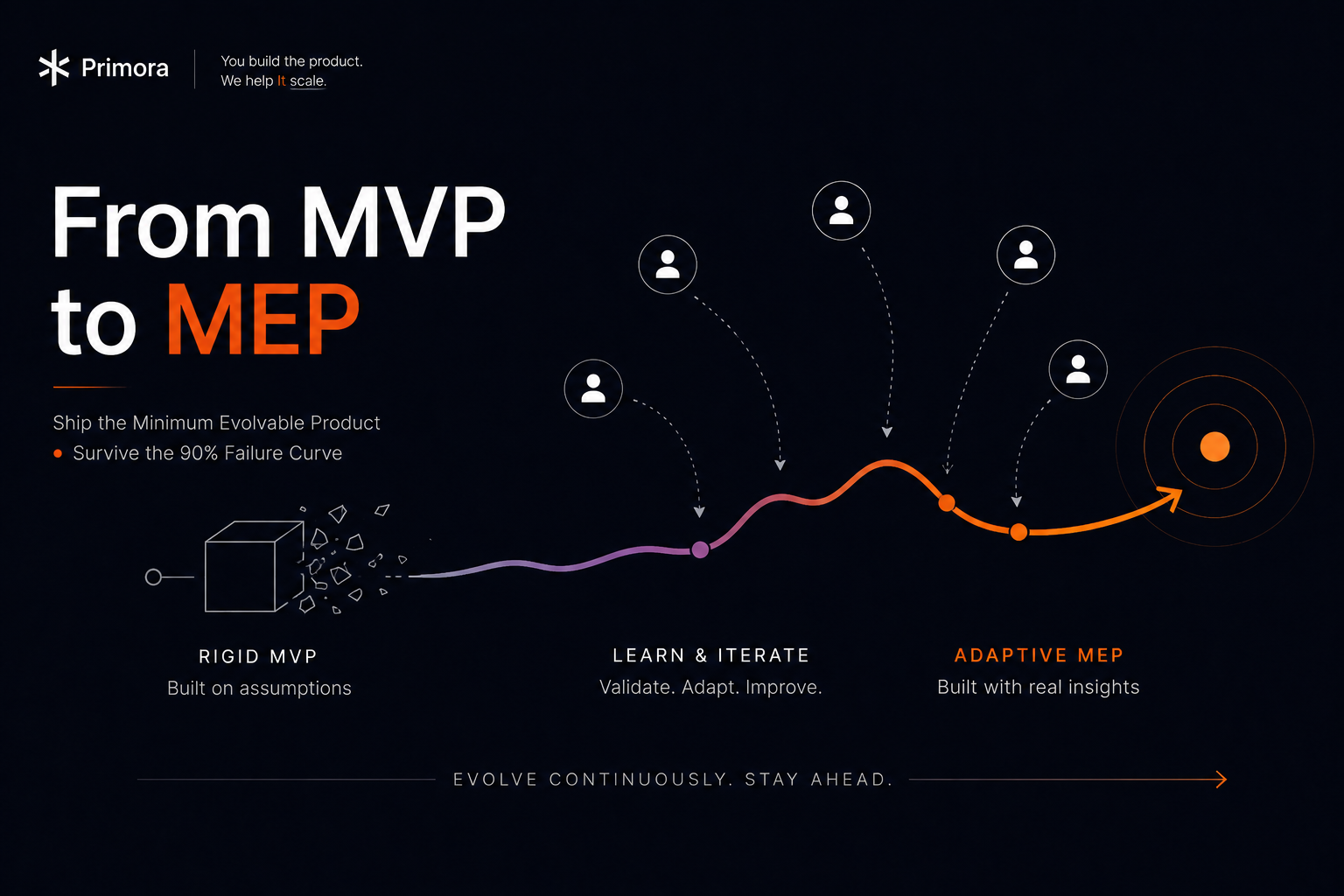
Waiting for a flawless launch is the wrong game. Top founders treat their early product as a Minimum Evolvable Product (MEP), a flexible foundation built to absorb real-world feedback and pivot fast, rather than a rigid Minimum Viable Product (MVP) that's "good enough" today but costly to change tomorrow.Here's how iconic companies survived the Valley of Death by prioritizing evolution over perfection.
Humble Beginnings Are the Rule, Not the Exception
Stripe, Airbnb, and countless others looked like any other garage startup at first. Success comes from survival, not initial brilliance.
Early validation demands manual, unscalable work. Data from the Startup Genome Project shows founders typically underestimate the time needed to validate their market by 2–3x.
A rigid MVP forces expensive rewrites when assumptions crumble. An MEP is designed for rapid iteration from day one.
Bias for Action Beats Over-Planning
Action generates real data; over-planning breeds delusion. In fact, founders overestimate the value of their intellectual property before PMF by an average of 255%. Velocity is the only antidote.
When the co-founders of Solugen came up with a way to make bio-based hydrogen peroxide using plant-based enzymes, they didn’t sit around writing a 50-page business plan or waiting for millions in venture capital to construct a heavy chemical plant.
Instead, they bought a commercial hot tub on Craigslist, hacked its heating and pump systems inside a Houston garage, and used it as a makeshift bioreactor to brew their first small batches.
They immediately sold that initial batch to a local float-spa owner for a few hundred dollars. It wasn't an industrial-scale operation, but it was definitive, real-world proof that a paying customer wanted what they were making. That raw traction is what eventually unlocked billions in valuation.
MVP Mindset: "Can we build this?"
MEP Mindset: "How fast can we change this when reality hits?"
Pivoting Is a Feature, Not a Bug
Your first idea is usually just a hypothesis. The path to product-market fit is rarely a straight line; it is an evolution born from paying attention when your original plan falls apart.
Consider the story of Segment. When the founders entered Y Combinator, they weren't building a multi-billion-dollar data routing platform. They spent over a year and half a million dollars building a classroom lecture tool that allowed students to press a button saying "I don't understand."
During live testing, the founders watched students open the app, look at the button, and immediately switch tabs to Facebook. The product was a total ghost town.
With only a few months of cash left, the team realized their original software was completely dead. But in building it, they had written a tiny, 500-line library of internal code just to send their user data to different analytics tools like Mixpanel and Google Analytics. They decided to strip away everything else, open-source that single piece of internal scaffolding on GitHub, and call it Analytics.js.
Within days, it went viral on Hacker News. They had spent two years building a complex, heavy MVP that nobody wanted, only to find their true product hidden in a lightweight, evolvable piece of infrastructure they wrote just to support their internal operations.
The data confirms that this pattern is the rule, not the exception: startups that pivot once or twice achieve 3.6x better user growth and raise 2.5x more capital than those that stubbornly stick to a broken plan or pivot erratically.
A rigid MVP makes a pivot like Segment’s incredibly painful and destructive because it forces you to throw away months of heavy, custom-built application logic. An MEP bakes adaptability straight into your workflow, recognizing that what you are building today is just the scaffolding for what you will discover tomorrow.
Embrace the Pain,It's the Path
Real entrepreneurial journeys feature multiple near-death moments, brutal feedback, and operational fire drills. Data from the U.S. Bureau of Labor Statistics shows a sobering reality: roughly 20–22% of businesses fail in year one, and nearly 50% vanish by year five.
The tech giants we admire today didn’t get a pass on this grueling phase. They survived simply because they built systems and personal tolerances to outlast it.
Think about the early days of Airbnb. In 2008, the company was completely broke, drowning in credit card debt, and rejected by every single venture capitalist they pitched. Nobody believed that letting strangers sleep on air mattresses in someone else's living room was a viable business concept.
Instead of throwing in the towel, the founders leaned heavily into unscalable, chaotic survival mode. To keep the lights on during the 2008 U.S. presidential election, they bought generic cereal in bulk, designed custom satirical boxes called "Obama O’s" and "Cap’n McCain’s," and hand-glued the cardboard flaps together in their kitchen.
They sold those boxes on the street for $40 a pop, netting $30,000. It wasn't elegant, it had absolutely nothing to do with software code, and it definitely didn't scale.
But it bought them exactly what an evolvable strategy requires: time.
When they finally got into Y Combinator, Paul Graham didn't accept them because he loved the Airbnb product idea; he accepted them because they had survived on cereal. He famously told them,
"If you can convince people to buy a $40 box of cereal, you can probably convince them to sleep on each other's floors."
The giants didn't bypass the pain; they treated their first launch as a living experiment, accepted churn as raw data, and rebuilt continuously. They understood that the early stage isn't a polished press release it’s an operational wrestling match where the ultimate prize is simply staying alive long enough for the market to catch up to your vision.
De-Risking the Chaos
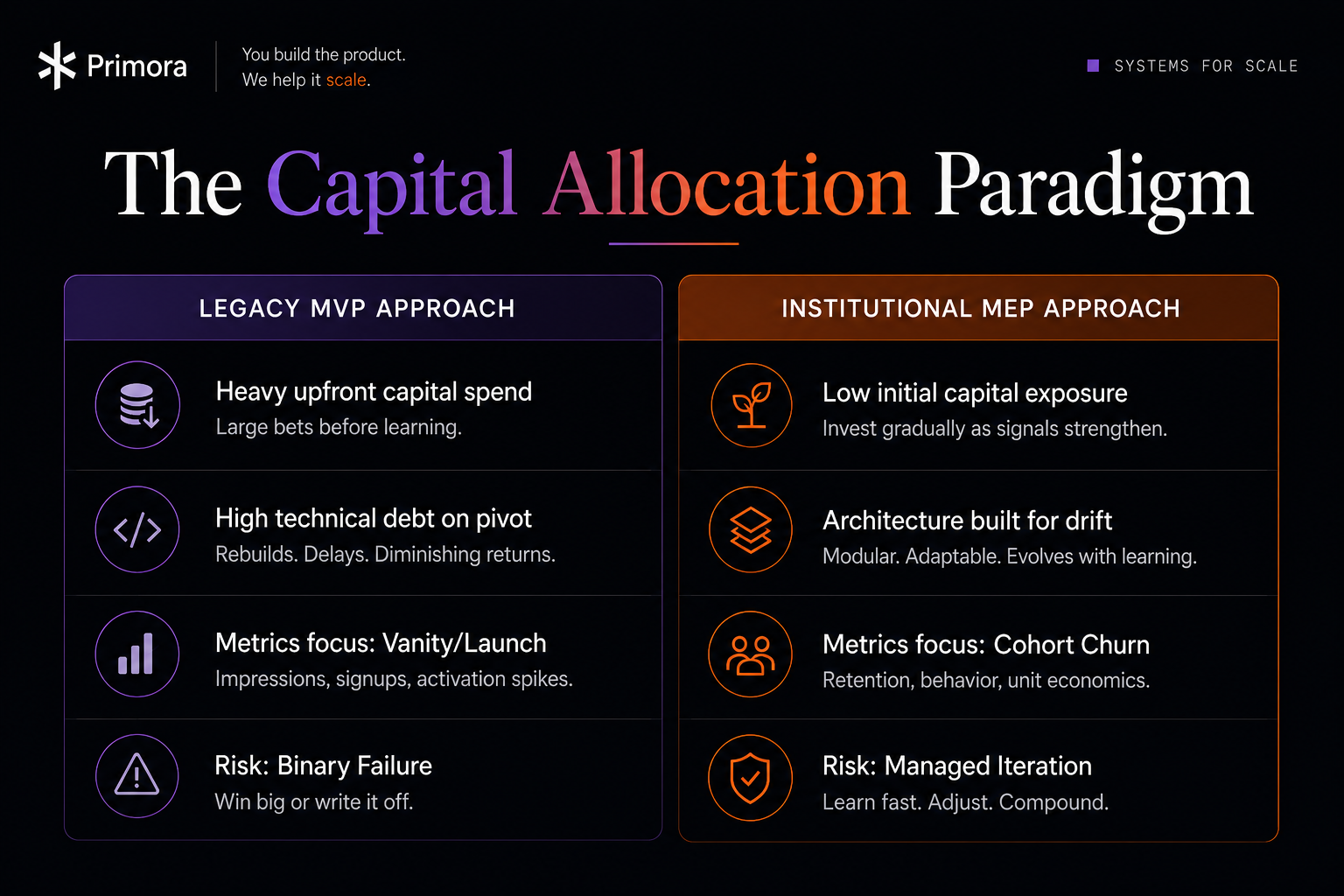
For founders and investors alike, shifting from a rigid MVP to a Minimum Evolvable Product isn't just about shipping code faster, it’s a cold, calculated strategy for capital preservation.
Think of Stewart Butterfield and his team at Tiny Speck. They spent over three years and millions of dollars building an ambitious, complex multiplayer online game called Glitch. When they realized the game was a commercial failure, they didn’t double down or go under. Instead, they ruthlessly cut the game and looked at what was left: a scrappy, lightweight internal chat system they had built purely to communicate across offices.
They stripped away the heavy game infrastructure, put a clean interface on that internal tool, and launched it as Slack.
The primary reason 90% of startups fail isn't a lack of ambition; it’s that teams over-capitalize unverified assumptions. They burn their runway building a beautiful, heavy monument to a guess, leaving themselves zero room to maneuver when the market tells them they’re wrong.
An MEP turns product development from a high-stakes gamble into a series of cheap, fast experiments. You don’t optimize for a flawless launch; you optimize for the lowest possible cost per iteration.
Product-market fit is never a permanent trophy. It’s a moving target. The companies that survive the Valley of Death don't succeed because their first guess was right.
They succeed because their product architecture was flexible enough to bend, absorb the punch of real-world data, and change shape before the bank account hit zero.
You can't control the macro environment, but you can control how brittle your company is. Build something light enough to evolve, measure the data with brutal honesty, and let the market tell you what to build next.






Build beyond the current cycle
Markets move. Interfaces evolve. Incentives shift. What endures is structure. If your ambition extends past momentum,