Mute the World, Build Your Own: What 400 Founder Biographies Reveal About the Founder Mindset
The best founders don't follow a playbook. After studying 400+ biographies, one pattern emerges: they operate on a different psychological frequency than everyone else around them.




Every few years, the tech world tries to turn elite founders into scientists. We dissect their morning routines, copy their management frameworks, and publish playbooks hoping to replicate their output.
But if you actually sit down and study hundreds of history’s greatest builders, a much weirder reality emerges: the best founders aren’t just hyper-efficient workers, they operate like a different species.
They have a rare, almost unsettling ability to mute the world and construct their own reality. Where everyone else sees standard industry rules, they see suggestions. To understand how they actually pull it off, you have to look past the spreadsheets and look at the raw psychological trade-offs happening under the hood.
Focus vs. Obsession: Switching Your Fuel Source
We throw the word "focus" around in corporate meetings all the time, but real focus is much more ruthless than a neat to-do list.
"Focus is saying no to a good idea that you really want to do because it distracts you from a great idea."
Saying no to bad ideas is easy. The hard part, the part that separates world-class operators from the rest, is killing a good, profitable, fun idea because it’s a distraction from the one thing that actually matters.
That level of focus almost always starts as raw obsession. In the early days, that obsession is usually driven by something personal: a point to prove, a chip on the shoulder, or an old insecurity. As the saying goes, "the story of the father is embedded in the son."
Chip-on-the-shoulder energy is fantastic for getting a rocket off the launchpad. But here's the catch: anxiety and spite are dirty fuel sources. If you rely on them too long, they burn through the hull.

"At some point, you have to change your fuel source from something that punishes you to something that generates."
The founders who survive long-term are the ones who learn to make this switch, pivoting from a need to prove people wrong to a genuine, self-sustaining drive to build something great.
Ditch the "Steve Jobs" Myth: Finding Founder-Problem Fit
Silicon Valley treats Product-Market Fit like the end-all-be-all. But Product-Market Fit is actually a lagging indicator. The real leading indicator is Founder-Problem Fit.
There’s a common misconception that to build a billion-dollar company, you have to be an aggressive tyrant. So people try to copy Steve Jobs or Elon Musk. But history shows that iconic builders come in all shapes and sizes. You have quiet architects, obsessive coaches, visionary storytellers, and ruthless commanders.
What matters isn't being a specific type of person, it’s whether your personal compulsions align with the problem you're solving.
When your natural wiring matches the core struggle of the industry, work stops feeling like a grind. You aren't forcing yourself to work 80-hour weeks; you’re just expressing who you are. The goal isn't to mimic someone else’s persona, but to find the problem that fits your exact brand of crazy.
The Uncomfortable Reality of the "Balanced" Founder
There’s a popular narrative today that with enough biohacking, task-delegation, and cold plunges, you can build an iconic enterprise while living a balanced, peaceful life.
The data says otherwise. Out of 400+ historic founder biographies studied, almost none of them had what anyone would call a "well-adjusted" life.
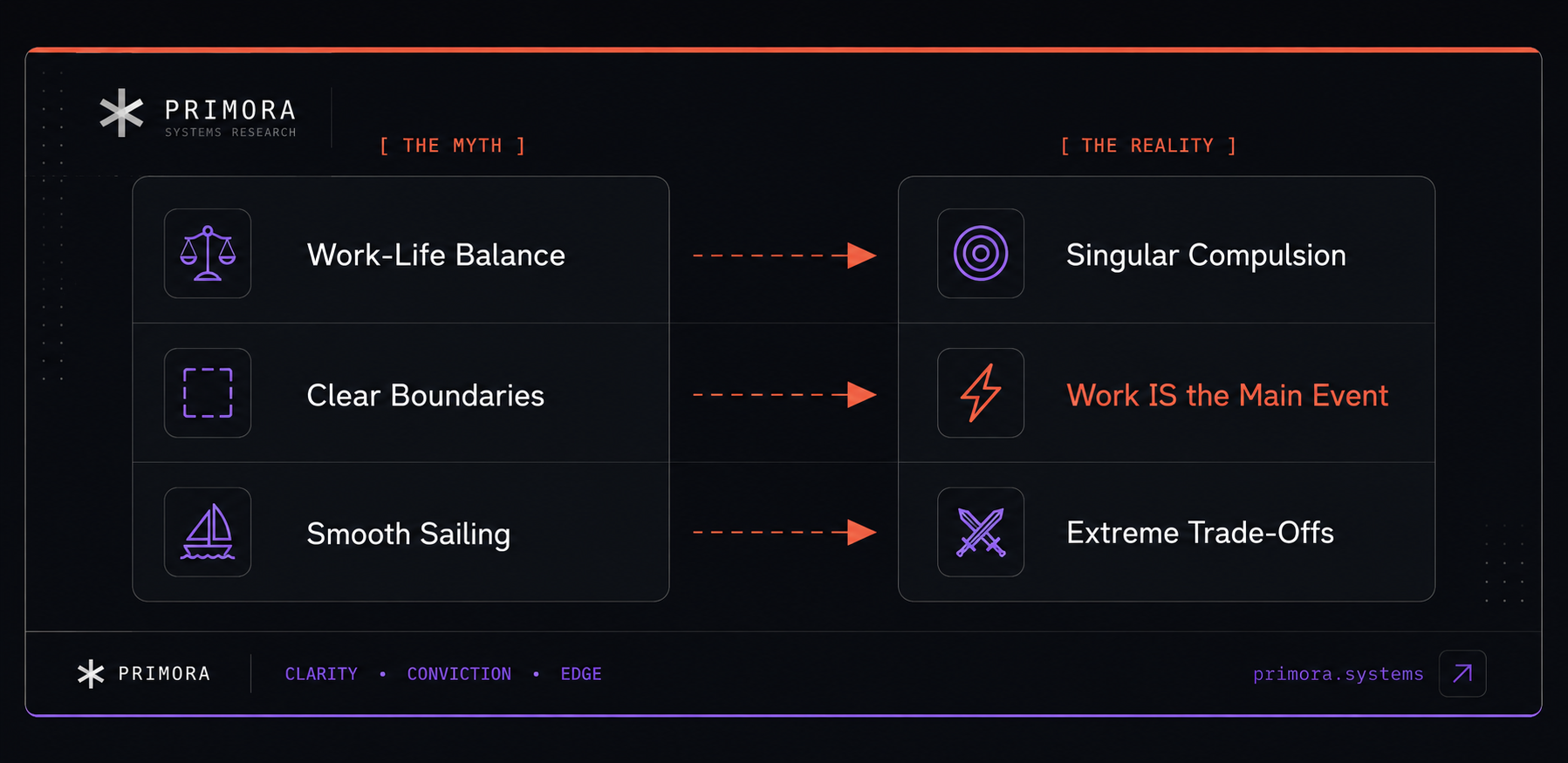
The trade-offs are real and steep. Family time, friendships, and peace of mind are frequently paid as tribute. For the top 1% of builders, entrepreneurship isn't a career choice or a day job, it's an inescapable compulsion. Trying to force an iconic founder into a normal, balanced routine is like asking a hurricane to tone it down to a breeze.
The AI Shift: Unlocking Infinite Leverage
While human psychology hasn't changed much over the centuries, the toolset just underwent a massive upgrade.
Historically, scale required headcount and capital. If you wanted to build something massive, you had to manage thousands of people and burn through millions of dollars.
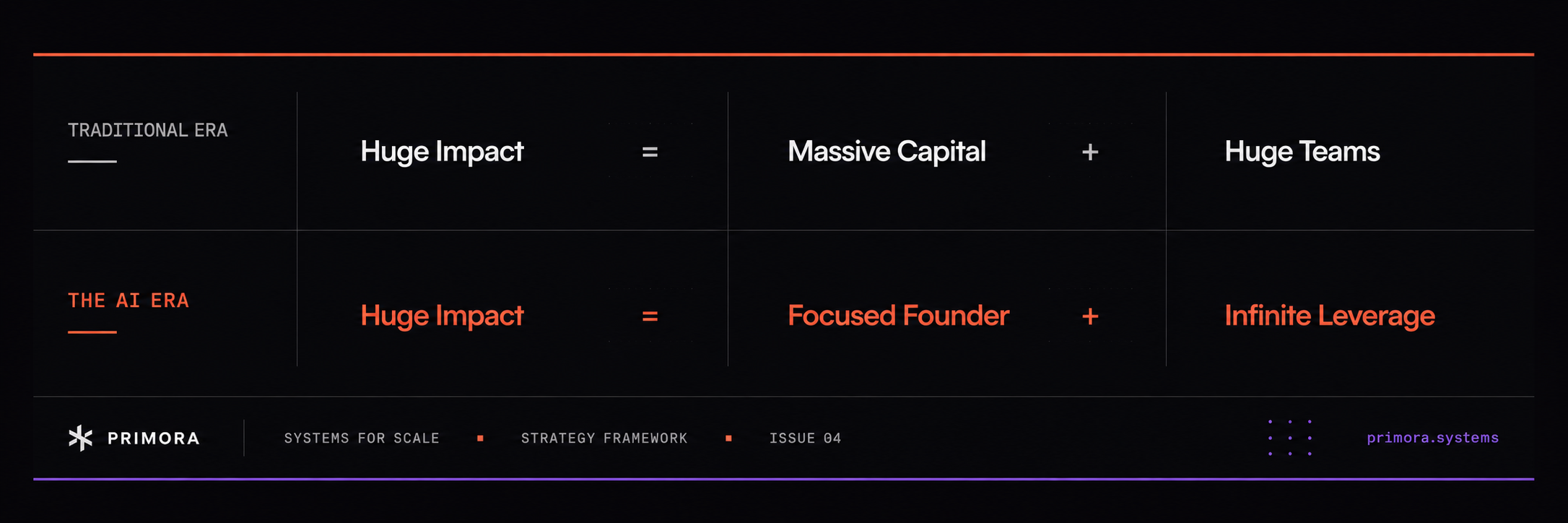
AI gives individual builders infinite leverage. A tiny team or even a single, relentless founder can now orchestrate systems, code, and distribution that used to require a corporate army.
When execution friction drops to zero, the bottleneck is no longer budget or headcount. The only bottleneck left is the clarity of the founder’s vision and their willingness to execute it.

Know Who You Are First
At the end of the day, legendary founders aren't manufactured by accelerators or predicted by VC algorithms. You don't "find" them, they make themselves undeniable.
If there’s one lesson to take away from history’s greatest builders, it’s not a growth hack or a management framework. It’s a call for radical self-awareness.
Before you try to change an industry, you have to strip away the noise and get honest with yourself: Who are you, what actually drives you, and what world are you willing to sacrifice to build?





Build beyond the current cycle
Markets move. Interfaces evolve. Incentives shift. What endures is structure. If your ambition extends past momentum,