Patrick Collison: Why the Classic Lean Startup Playbook Is Obsolete
Patrick Collison says the lean startup era is over. At YC Startup School 2026, he made the case for bigger ambitions, deeper knowledge, and choosing problems worth decades of your life.



At Y Combinator’s Startup School 2026, Stripe co-founder and CEO Patrick Collison sat down with YC partner Harj Taggar for a wide-ranging conversation on the state of technology and entrepreneurship. Seventeen years after Collison himself attended Startup School as a young founder, his message to the next generation of builders was both encouraging and transformative: artificial intelligence is fundamentally changing how companies are conceived, built, and scaled.
For over fifteen years, Silicon Valley operated under the gospel of the "Lean Startup" start small, target a tight niche, test with minimal capital, and iterate slowly.
According to Collison, that era is coming to a close. Powered by AI capabilities and shifting market dynamics, founders now face a completely rewritten playbook.
Below are the four core takeaways from Collison’s address, detailing what they mean for modern founders building in an AI-first economy.
The End of the "Lean Startup" Monopoly
The traditional lean startup playbook advocated starting with a narrow, highly constrained scope to minimize burn while searching for product-market fit. While that framework protected scarce engineering capacity in the 2010s, Collison highlighted that AI software agents have dramatically reduced the cost of multi-faceted production.
Niches today are "much more competitive and much more aggressively tilled," Collison noted. Trying to start in a tiny, crowded micro-niche often means competing in over-optimized space. Because AI makes it drastically cheaper to "spin up an organization with many different potentialities and capabilities," founders no longer need to restrict their initial vision to a hyper-specific, low-complexity product.
What This Means for Founders
- Build Ambitious V1s: AI allows small teams to construct sophisticated, multi-feature software systems right from day one.
- Decorrelate From the Crowd: Instead of pursuing minor variations of existing applications, take divergent technical and operational paths that competitors are ignoring.
A Golden Age of Founding and Accelerated Traction
Addressing fears that frontier AI labs or incumbents might crowd out early-stage startups, Collison offered empirical evidence to the contrary. Drawing from Stripe’s internal platform analytics, he revealed unprecedented shifts in macroeconomic company creation:
- Record Business Creation: Stripe is seeing nearly double the year-over-year rate of new business creation on its infrastructure.
- Faster Revenue Milestones: Contrary to the assumption that these new companies are merely lightweight "vibe-coded" experiments, Stripe data shows the median new startup is reaching meaningful revenue thresholds faster than cohorts from previous years.
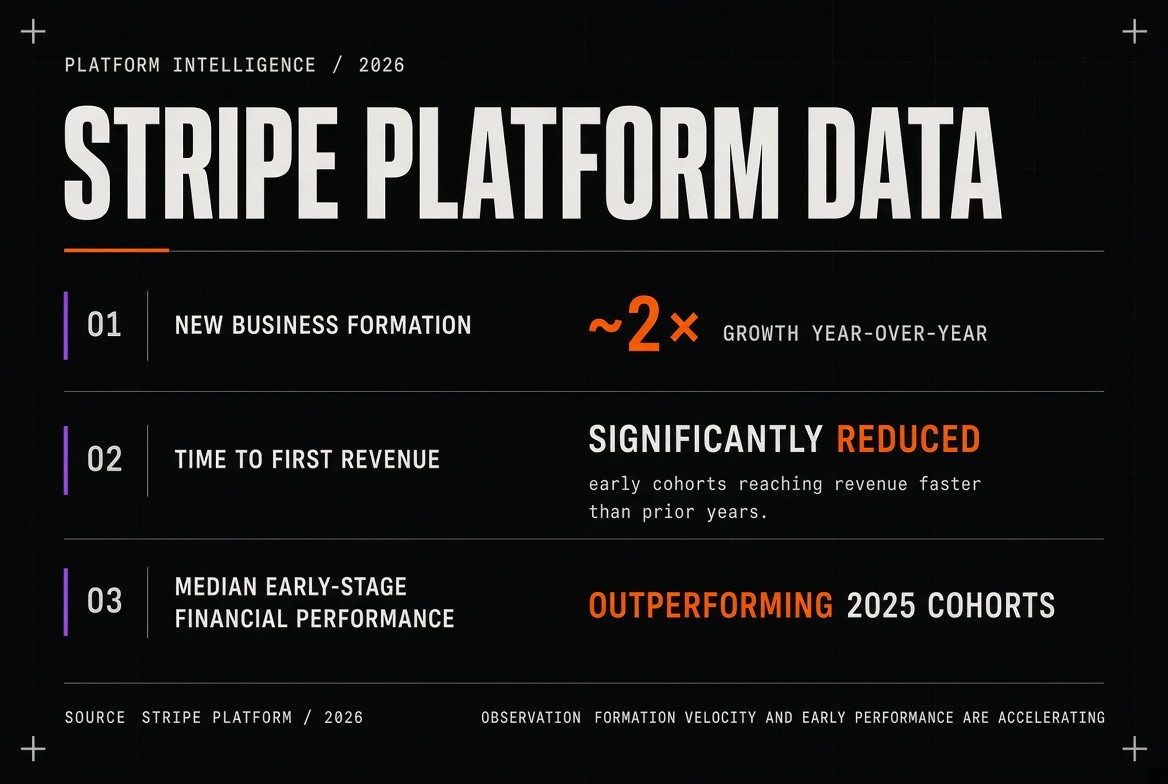
Collison explained that enterprise appetite for purchasing from young startups is at an all-time high, largely driven by a fear among established institutions of being left behind by technical shifts.
Knowledge Still Matters: The "Cognitive L1 Cache"
With modern AI tools handling code generation, research synthesis, and administrative workflows, a common question among young builders is whether deep technical learning remains necessary. Collison argued strongly that human cognitive depth remains a core competitive advantage.
Using a hardware metaphor, Collison described first-principles understanding as a founder's "cognitive L1 cache." While asking an AI agent to retrieve, verify, or compute information takes time (the round-trip latency of an API call or model query), having foundational knowledge stored directly in your own mind allows for immediate synthesis, rapid decision-making, and critical evaluation.
"Neuronal lookups in your own brain are still faster and more effective than outsourcing everything to models." — Patrick Collison
Key Cognitive Priorities for Builders
- Maintain First-Principles Thinking: Do not outsource core strategic judgment, architectural oversight, or critical communication to automated models.
- Evaluate AI Outputs Critically: Founders who understand underlying technical mechanisms can spot subtle hallucinations, design flaws, and flaws in logic that non-experts miss.
The "What If You Succeed?" Test
When founding a company, builders naturally evaluate risk by asking, "What happens if I fail?" Collison suggested that founders reverse their perspective and evaluate a far more consequential question: "What happens if I succeed?"
Building a venture-backed enterprise often requires a decade or more of intense dedication. If a founder builds a solution to a problem they find uninspiring purely because it presents a quick short-term market opportunity, success can result in spending ten to twenty years trapped in an domain they do not care about.
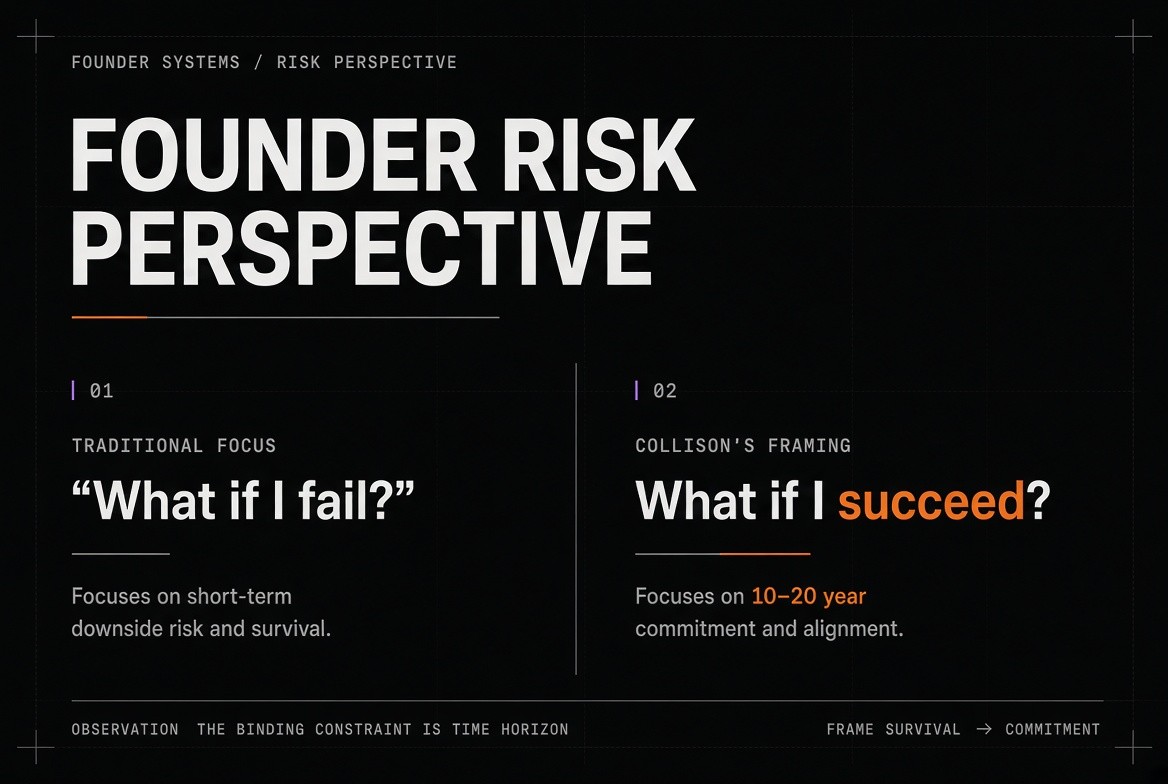
Collison advised founders to work on problems they are genuinely enthusiastic about prosecuting for twenty or thirty years. Long-term founder alignment with a domain ultimately dictates whether a company survives the operational friction inherent in scaling.
The takeaways from Patrick Collison's talk at Startup School 2026 underscore a pivotal shift in software entrepreneurship. As artificial intelligence drastically lowers the technical barrier to execution, the primary bottlenecks in startup creation have shifted from basic software production to vision, cognitive depth, and long-term problem alignment. For modern founders, success now hinges on building ambitious products from day one, mastering first principles, and choosing problems worth committing to for decades.







Build beyond the current cycle
Markets move. Interfaces evolve. Incentives shift. What endures is structure. If your ambition extends past momentum,