Why Low Ambition Kills Startups: The Founder Trap Nobody Warns You About
Aiming small feels safer but kills startups faster. Low ambition starves companies of talent, capital, and momentum. Here is why thinking bigger is actually the more practical strategy.



When building a company, many founders fall into a quiet trap: they lower their target. The logic seems sensible enough on paper. Aim for a modest, defensible niche, lower the technical complexity, and build something "safe." By reducing the scope, you lower the risk of total failure or so the theory goes.
In venture-backed technology, however, this strategy backfires consistently. Lowering your ambition does not increase your probability of success; it radically reduces it. Low ambition is one of the quietest killers of early-stage startups because it starves the company of the momentum, capital, and talent required to survive.
Understanding why ambitious goals succeed and how playing it safe actively harms a company is essential for founders navigating the early stages of product development and venture fundraising.
The Fallacy of Aiming Low
The central mistake founders make when choosing a project is treating risk as a linear scale tied to vision size. It feels safer to start a small software consultancy or build a minor feature iteration for an existing market than to tackle an industry-wide overhaul.
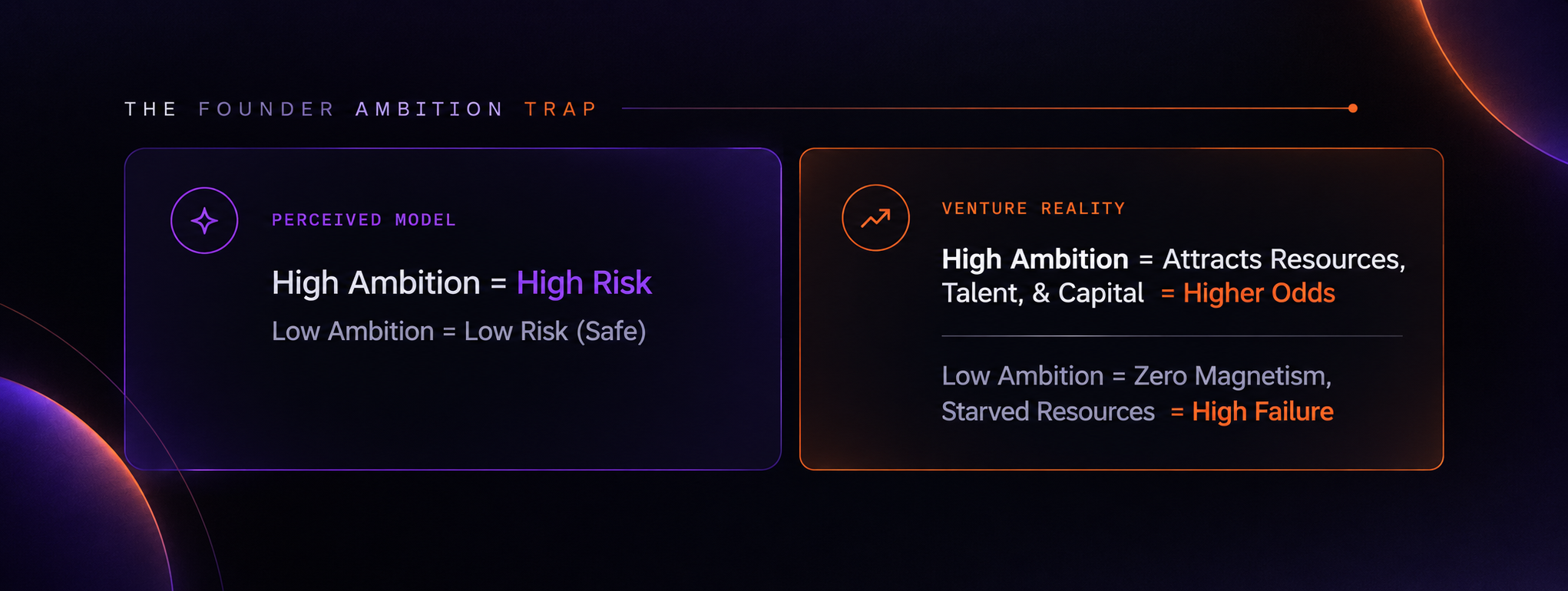
In the venture capital ecosystem, low-ambition startups rarely generate meaningful returns or reach sustainable scale. Small markets yield small revenues, which leave little margin for operational mistakes, hiring top talent, or enduring prolonged market downturns.
Why Investors Rarely Call Out Low Ambition
If low ambition is such a common failure mode, why don't founders hear it directly from venture capitalists?
Venture capitalists rarely tell a founder point-blank, "Your idea isn't ambitious enough." Direct feedback of that nature feels socially uncomfortable, dismissive, or arrogant. Instead, investors retreat to polite, transactional rejection phrases:
- "The Total Addressable Market (TAM) feels a bit small for us right now."
- "We’d like to see more user traction before making a commitment."
- "This falls slightly outside our core thesis at this stage."
These responses obscure the underlying issue. The problem usually isn't the current metrics or TAM calculation; it's that the core vision lacks the scale required to return a venture fund. Founders misread these rejections as operational hurdles to clear rather than a fundamental flaw in their ambition.
The Power of a Big Dream: Ambition as a Resource Magnet
Unreasonable ambition serves a practical, operational function in business building: it acts as a magnet for resources.
Starting a company is inherently difficult. In the early days, a startup has no brand, little capital, and no market power. The only asset a founder possesses is a compelling vision of the future.
The "Invisible Hands" of High Ambition
When a project aims to alter an industry or solve an existential problem, it activates invisible support networks. Highly ambitious ideas pull in critical resources that money alone cannot buy:
- Top-Tier Talent: Exceptionally capable engineers, designers, and executives rarely leave stable, high-paying jobs to build incremental tools. They move for hard, transformative problems.
- Early Capital: Investors want to back category-defining companies. A bold vision creates the upside potential that justifies early-stage investment risk.
- Customer Patience: Early adopters tolerate product bugs, downtime, and rough interfaces if the underlying product promises a major leap forward in utility.
The 100x Benchmark: Why Incremental Gains Fail
To capture market share from established incumbents, incremental improvements are insufficient. A product that is 10% or 20% better than existing solutions rarely overcomes the switching costs for users.
Founders must target a 100x improvement in user experience or efficiency.
Consider the launch of Gmail. When Google introduced Gmail, existing webmail providers offered small storage caps (often between 2 MB and 10 MB), forcing users to constantly delete messages. Gmail launched with 1 GB of free storage a roughly 100x to 500x increase over prevailing standards. That single, highly ambitious leap rendered existing solutions obsolete almost overnight.
Ambition Needs Substance: Logic and Domain Authority
Ambition alone is not a strategy. A bold declaration unsupported by clear execution mechanics is simply posturing. High ambition must be paired with rigorous internal logic and deep technical credibility.
Logical Leaps vs. Blind Hand-Waving
To build credibility with partners and investors, a founder must bridge the gap between their current reality and their large vision using sound, domain-specific logic.
When Elon Musk outlined early plans for space exploration and electric vehicles, the goals sounded extreme, but the underlying arguments were anchored in first-principles physics, raw hardware costs, and manufacturing unit economics. The vision was massive, but the steps to reach it were logical and ground-level.
Founders must ask:
- What specific structural change or technological shift enables this vision now?
- What are the clear, logical steps required to move from Step A to Step Z?
- Does the team possess the domain expertise required to execute those steps?
The Authority Test: Standing Against Consensus
The most ambitious, venture-scale ideas often look foolish or impractical to established industry experts. Conventional wisdom relies on past data, whereas breakthrough innovation relies on emerging realities.
If an idea is obviously brilliant to current market leaders, an incumbent is likely already building it. True breakthroughs require founders who are willing to look wrong to conventional experts while maintaining a logically sound, defensible thesis.
Avoiding the Startup "Tarpit"
One of the greatest personal risks for an entrepreneur is spending years locked into a low-ambition concept that neither fails fast nor grows into a real business.
The "Seenster" Warning: Aesthetic vs. Substance
It is easy to fall in love with the lifestyle of entrepreneurship while avoiding the actual execution. Industry commentators often point out the rise of the startup "seenster" individuals who spend their time attending panels, networking events, and pitch competitions while building products with minimal real-world impact.
Participating in the startup aesthetic is not the same as building an enterprise. True building requires focusing on core product execution, technical development, and direct customer value.
The Meta-Tarpit: The Ultimate Waste of Time
Working on a low-ambition project for three to five years is the ultimate professional tarpit. It consumes a founder's most creative years on an idea that, even in its best-case scenario, yields mediocre results.
If you currently lack a transformative, high-ambition idea, the worst response is to launch a low-ambition startup just to claim the title of founder. A far more strategic path is to join an already ambitious, high-growth company.
Working inside a fast-scaling startup provides exposure to hard problems, exposes you to top-tier talent, and gives you the operational insight, the "ambition pill" needed to identify a truly massive opportunity for your next venture.
Lowering your startup's ambition does not reduce its risk, it deprives the company of the energy, talent, and capital required to succeed. While big dreams require rigorous logic and deep domain execution, they also act as the primary catalyst for attracting the resources necessary to build category-defining institutions. Aiming low is the ultimate false safety net; building something genuinely transformative remains the most practical path forward.







Build beyond the current cycle
Markets move. Interfaces evolve. Incentives shift. What endures is structure. If your ambition extends past momentum,